EURYO · Publications
EURYO Library
Explore scientific articles, research reports, policy briefs, book chapters and publications from EURYO and its projects.
Search publicationsExplore by title, project, author, series, publication type or year Show filters
Latest publications
85 publications in the chronological list
Territorial Configurations of School‐To‐Work Outcomes in Europe
This article investigates differences in school-to-work transition outcomes across European regions rather than treating countries as uniform labour markets. It examines regional patterns and their evolution over time using territorial indicators, drawing attention to the role of subnational contexts…
View publicationDigital Transformation and Digital Competences of Urban and Rural Polish Youths
Using survey data from Polish adolescents, this study compares digital competences among young people in urban and rural areas. It identifies differences in several dimensions of digital skills and self-assessment, contributing evidence for educational policies addressing digital inequalities across…
View publicationNEETs and Youth Guarantee Registration: Examining the Link to Past Undeclared Work
This article examines the relationship between past undeclared work and registration with the Youth Guarantee among young people outside employment, education or training. It situates informal employment histories within a wider discussion of how vulnerable young people engage with…
View publicationSubjective Well‐Being of NEETs and Employability: A Study of Non‐Urban Youths in Spain, Italy, and Portugal
This comparative study considers how subjective well-being and employability relate to the experiences of young people not in employment, education or training in non-urban areas of Spain, Italy and Portugal. It contributes to understanding the personal and territorial dimensions…
View publicationPublic Employment Services' Responses to the Pandemic: Examples from Portugal, Bulgaria, and Lithuania
Drawing on experiences in Portugal, Bulgaria and Lithuania, this study examines how public employment services adapted their support for young people during the COVID-19 pandemic. It considers the benefits of remote service delivery alongside digital-access barriers in rural areas,…
View publicationPublic Employment Services and Vulnerable Youth in the EU: The Case of Rural NEETs
This article assesses the opportunities and risks of digitalising public employment services for vulnerable young people, particularly rural NEETs. It argues that effective digital support requires attention to trust, institutional transformation and co-design, rather than assuming that introducing online…
View publicationActive Labour Market Policies and Youth Employment in European Peripheries
This thematic issue of Politics and Governance brings together research on active labour market policies and young people's employment prospects in European peripheral regions. The contributions examine public employment services, rural NEETs, territorial inequalities, digitalisation and the design and…
View publication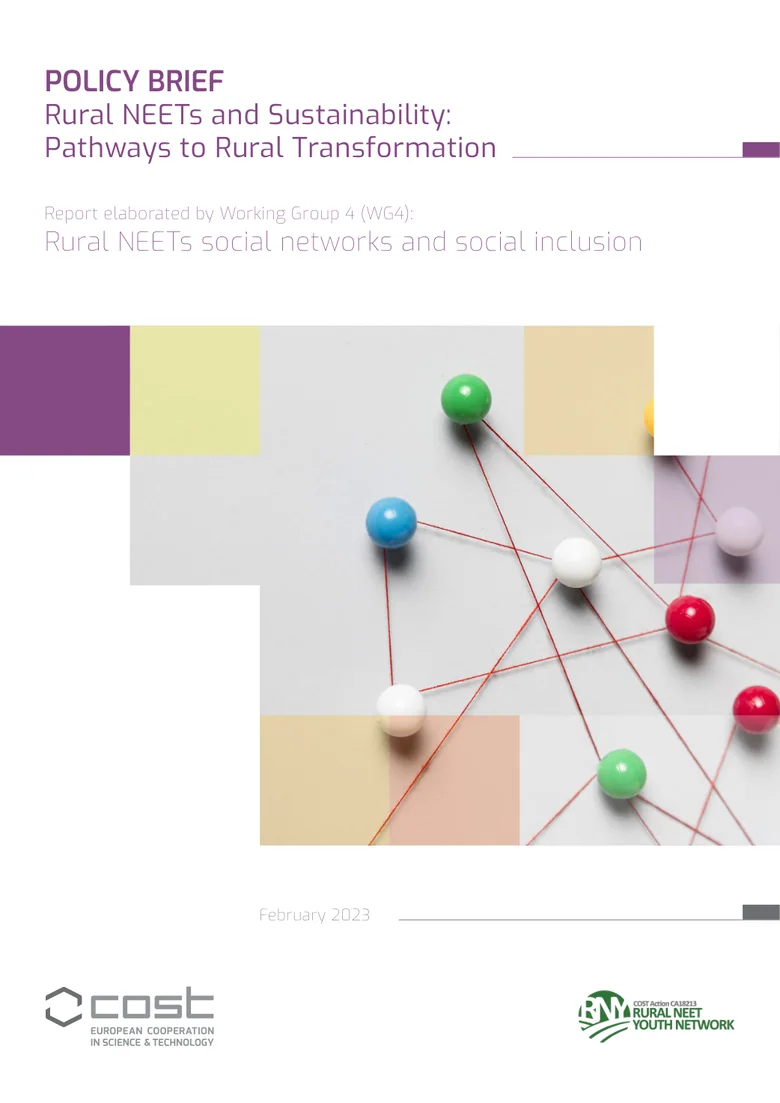
Rural NEETs and Sustainability: Pathways to Rural Transformation
This policy brief examines the relationship between rural NEETs, sustainability and pathways for transforming rural areas. It considers the inclusion of young people in education, employment and community life as part of broader social, economic and environmental rural-development agendas.
View publicationPredictors of Secondary Education Completion across Portuguese Municipalities: Evidence from the 2009–2018 Period
This study examines predictors of secondary education completion across Portuguese municipalities between 2009 and 2018. It uses a territorial perspective to investigate variation in educational attainment and the conditions associated with successful completion of secondary schooling.
View publicationNational Level Support Programs for Youth in Relation to Effective School-to-Work Transition: Examples of Italy, Moldova, and Latvia
This article reviews national programmes supporting young people in their transition from school to work, drawing on examples from Italy, Moldova and Romania. It considers policy approaches and the role of institutional support in improving educational and employment pathways.
View publication